Why Choose Aluminium Washroom Doors for Global Projects?
Global washroom design is becoming more demanding. Doors must withstand humidity, frequent cleaning, heavy traffic, and different installation standards. An Aluminium Washroom Door offers a practical response because aluminium is lightweight, corrosion-resistant, and adaptable to varied project conditions. Its slim frames also create cleaner cubicle lines, especially in airports, hospitals, schools, and commercial towers.
The United Nations Environment Programme’s 2023 Global Status Report states that buildings produced 37% of global energy-related emissions in 2022. Material selection therefore deserves closer attention. The Aluminum Association reports that recycling aluminium saves approximately 95% of the energy required for primary production. The International Aluminium Institute also identifies buildings as a major destination for aluminium products. These figures support long service life and responsible material recovery. They do not make every door automatically sustainable. That distinction matters.
Materials scientist Mark Miodownik writes, “Materials are the stuff of life.” His point is useful for washroom planning. A door is not merely a panel on hinges. It is touched thousands of times, exposed to water, and judged under harsh lighting. Aluminium can support durable finishes, replaceable hardware, and efficient transportation because of its low weight. Yet poor detailing may still cause noise, misalignment, or premature damage. Global projects need tested specifications, experienced installers, and clear maintenance instructions. Sometimes, the best choice is less obvious. This article examines why an Aluminium Washroom Door can balance performance, appearance, lifecycle value, and project reliability across demanding environments.
What Are Aluminium Washroom Doors?
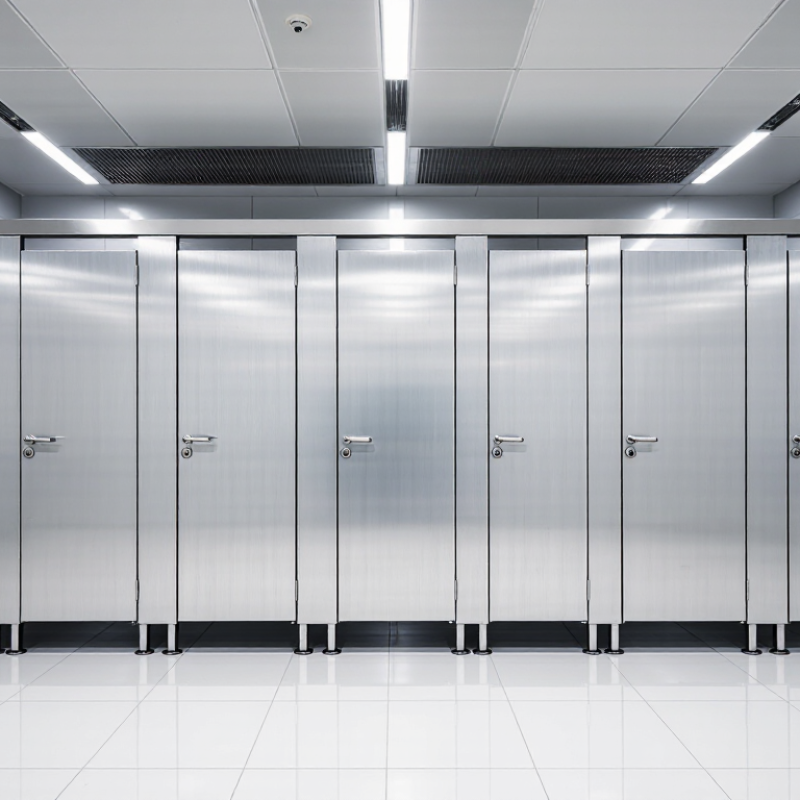
Aluminium washroom doors are lightweight doors designed for toilets, changing rooms, and wet public facilities. They usually combine an aluminium frame with an aluminium sheet, laminate, or compact panel. This structure creates a stable barrier around each cubicle or service area. The frame supports hinges, locks, handles, and adjustable feet.
On international projects, I have seen these doors used in airports, schools, hotels, hospitals, and construction camps. Aluminium resists rust better than ordinary steel in humid environments. It also remains easy to handle during installation. A typical door can be cut, aligned, and repaired with common site tools. However, quality depends on the alloy, coating, hardware, and installation method. Aluminium alone does not guarantee long service.
Good designs include rounded edges, concealed fixings, moisture-resistant cores, and strong privacy locks. Door gaps should support ventilation without exposing users. Accessible cubicles need suitable clear widths, opening forces, and handle positions. These details must follow the project’s local building and accessibility requirements.
They are not indestructible. Heavy impact can bend thin panels, and poor drainage can stain lower sections. That weakness matters. Project teams should check panel thickness, surface treatment, hinge strength, and replacement access before approval. Cleaning chemicals also require testing, because aggressive products may damage finishes. A reliable specification balances appearance, hygiene, installation speed, maintenance, and the conditions of each country.
Why Choose Aluminium Washroom Doors for Global Projects? - What Are Aluminium Washroom Doors?
| Data Dimension | Typical Data or Specification | Relevance to Global Projects |
|---|---|---|
| Door Definition | A washroom door made with an aluminium frame, aluminium sheet, aluminium honeycomb, or composite infill panel. | The construction can be adapted for toilet cubicles, restroom entrances, shower areas, changing rooms, and high-traffic public facilities. |
| Core Material | Common options include aluminium honeycomb, rigid foam, mineral core, or a solid aluminium panel. | The core affects weight, rigidity, acoustic performance, moisture resistance, and compliance with project-specific fire requirements. |
| Typical Door Thickness | Approximately 30–45 mm for many interior washroom door systems. | The final thickness depends on the frame profile, panel construction, hardware, acoustic target, and local specification. |
| Aluminium Alloy | Architectural systems commonly use 5xxx or 6xxx series aluminium alloys. | 6xxx series alloys are widely used for extruded frames, while 5xxx series alloys are often selected for sheet applications requiring good corrosion resistance. |
| Surface Finishes | Anodized Powder Coated PVDF Coated | Finish selection should consider humidity, cleaning chemicals, ultraviolet exposure, colour requirements, and the expected maintenance schedule. |
| Corrosion Resistance | High resistance to moisture-related corrosion when the alloy, finish, fasteners, and installation details are correctly specified. | This makes aluminium suitable for humid washrooms, coastal buildings, aquatic facilities, hospitals, schools, airports, and commercial developments. |
| Moisture Performance | Non-hygroscopic metal surface; aluminium does not absorb water like untreated wood-based materials. | Edges, joints, seals, wall interfaces, and drainage details still require proper design to prevent water ingress and staining. |
| Approximate Panel Weight | Often lighter than many solid-core or masonry-related door constructions; exact weight varies by size and core. | Lower door weight can simplify handling, reduce hardware loading, and support faster installation, but hinges and fixings must still be correctly rated. |
| Maintenance Requirement | Routine cleaning with water and a mild, non-abrasive detergent; periodic inspection of hinges, locks, seals, and fixings. | Avoid strong acids, aggressive alkalis, abrasive pads, and incompatible chemicals that may damage the finish or accelerate corrosion. |
| Hygiene Consideration | Smooth, sealed surfaces with limited exposed joints can be cleaned efficiently. | For healthcare and food-service environments, specify cleanable profiles, suitable sealants, rounded or protected edges, and finishes compatible with the cleaning protocol. |
| Hardware Options | Common hardware includes stainless-steel or corrosion-resistant hinges, indicator bolts, pull handles, coat hooks, door stops, and emergency-release devices. | Hardware should be selected for traffic level, humidity, vandal-resistance requirements, accessibility, and regional availability of replacement parts. |
| Door Swing and Accessibility | Inward or outward swing can be used according to room layout; accessible washrooms generally require clear opening and manoeuvring space defined by local regulations. | Global projects must verify dimensions against the applicable accessibility standard rather than relying on one universal size. |
| Fire Performance | Standard interior washroom doors are not automatically fire-rated. Fire resistance depends on the complete tested door assembly. | Where a fire-rated opening is required, use a door, frame, seals, glazing, and hardware assembly tested and approved for the relevant jurisdiction. |
| Acoustic Performance | Sound reduction varies significantly with panel core, seals, frame design, and installation quality. | For hotels, offices, healthcare facilities, and residential buildings, request a tested acoustic value when privacy is a key requirement. |
| Service Life Factors | Durability depends on alloy, coating quality, hardware grade, impact exposure, cleaning chemicals, humidity, and installation. | A complete system specification is more reliable than judging service life from the aluminium material alone. |
| Sustainability Profile | Aluminium is recyclable, and recycled aluminium generally requires substantially less energy to produce than primary aluminium. | Environmental performance should be assessed using project-specific recycled content, manufacturing data, transport distance, coating process, and end-of-life plans. |
| Installation Method | Typical methods include mechanical fixing to prepared openings, adjustable frames, concealed fixings, and site-applied seals. | Accurate opening dimensions, compatible substrates, tolerance allowances, and coordinated interfaces reduce installation delays across different countries. |
| Best-Fit Applications | Airports Schools Hotels Hospitals Sports Facilities | Aluminium washroom doors are especially practical where moisture resistance, frequent cleaning, low maintenance, and consistent appearance are important. |
FAQS
They serve toilets, changing rooms, and wet public facilities. Each door creates privacy around a cubicle or service area. Common locations include schools, airports, hotels, hospitals, and construction camps.
Aluminium resists rust better than ordinary steel. It is also lightweight during installation. However, aluminium alone does not guarantee long service. Coating, hardware, and drainage still matter.
The frame may support an aluminium sheet, laminate, or compact panel. Some panels include moisture-resistant cores. The final choice depends on impact, cleaning routines, appearance, and humidity.
Rounded edges reduce injury risks and simplify cleaning. Concealed fixings prevent dirt traps. Proper door gaps support ventilation without exposing users. Small details matter.
Approved drawings guide the cutting and drilling process. Computer-controlled tools create consistent frame lengths. Components are deburred before assembly. Factory teams test hinges, locks, alignment, and door swing.
They should check wall levels, floor slopes, and opening dimensions. Uneven concrete can affect a perfect design. Adjustable hinges can help with small alignment problems. Not always enough.
Buyers should define traffic levels, humidity, cleaning chemicals, opening sizes, and expected service life. They should also check the alloy, coating, panel core, hinges, locks, and fixing method. Appearance is only one part.
Yes, suppliers should provide complete test records and installation instructions. A sample installed in a wet area may reveal water marks, sharp edges, or weak hardware. This step is often missed. That can be costly.
Conclusion
An Aluminium Washroom Door is a practical solution for commercial, institutional, hospitality, healthcare, and public projects that require durability, hygiene, and consistent performance. Made from corrosion-resistant aluminium profiles, panels, hardware, and suitable finishes, these doors can be designed in various sizes, colors, opening styles, and privacy configurations. Modern manufacturing processes support accurate fabrication, smooth installation, and reliable quality control, helping projects achieve both functional and visual consistency.
For global projects, teams should evaluate moisture resistance, structural strength, impact performance, fire and safety requirements, privacy, accessibility, maintenance needs, and compatibility with local construction conditions. Buyers should also confirm dimensions, material specifications, surface treatments, hardware options, testing documentation, packaging, delivery capability, and installation support before placing an order. By matching the Aluminium Washroom Door system to the building’s use, climate, traffic level, and compliance requirements, project teams can achieve a long-lasting, hygienic, and cost-effective washroom solution.