CE Certified Aluminum Shopfront Doors Factory & Supplier

Architectural-Grade Glazing Systems, High-Traffic Commercial Entrances, and Bespoke Façade Solutions Engineered Under EN 14351-1 Standards.

Commercial & Residential Portfolio

Featured Commercial Shopfronts & Specialized Architectural Systems

Precision-machined structural extrusions, dual-seal weather barriers, and multi-laminated safety glass tailored for global retailers, high-footfall venues, and upscale developments.

180,000+
m² Production Base
25+
Years Manufacturing Experience
600+
Skilled Craftsmen & Engineers
100+
Global Patents & Certifications

Engineering Excellence: CE-Certified Aluminum Shopfront Doors for High-Traffic Commercial Enclosures

Modern commercial architecture mandates an intricate balance between open-sightline aesthetics, extreme structural rigidity, robust thermal management, and pedestrian life safety. When evaluating an aluminum shopfront door system—whether for an international high-street retail outlet, a corporate headquarters reception, or a high-footfall transport terminal—procurement managers and facade consultants must look beyond surface treatments. Compliance with rigorous international standards, notably the European Union’s CE Marking (EN 14351-1: Windows and Doors Product Standard), serves as non-negotiable verification of structural performance, air permeability, water tightness, and structural wind resistance.

As an industry-leading manufacturer with over two decades of technical evolution in Foshan, China—the epicenter of high-end structural extrusion manufacturing—DERCHI (Guangdong Dejiyoupin Doors and Windows Co., Ltd.) integrates structural structural aluminum alloys (primary 6063-T5 and structural 6061-T6 profiles) with state-of-the-art thermal break technologies. This ensures that every storefront entrance delivers uncompromising durability under continuous cyclic loads exceeding 1,000,000 openings.

Critical Technical Insight: The True Scope of CE Marking (EN 14351-1)

A valid CE certification for an aluminum shopfront door does not merely cover raw alloy chemical compliance. It validates full-assembly physical testing conducted by notified bodies: air infiltration under negative and positive pressure, water penetration under dynamic wind driving, wind load deflection (Class C3/B3), and load-bearing capacity of integrated safety hardware.

Material Science & Mechanical Durability: 6063-T5 vs. 6061-T6 Commercial Profiles

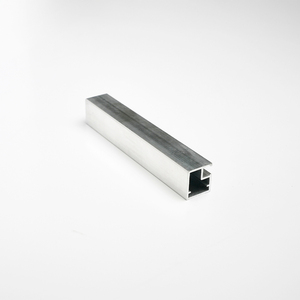
The operational lifecycle of a commercial shopfront door hinges heavily on the metallurgical profile specifications. Standard residential windows regularly leverage thin-wall extrusions ranging from 1.2mm to 1.4mm. In stark contrast, authentic commercial shopfront entrances require cross-sectional wall thicknesses between 2.0mm and 3.5mm at critical structural junctions, hinge attachment pockets, and floor-pivot anchor blocks.

  • Alloy 6063-T5: Offers exceptional surface finish quality, making it ideal for architectural anodizing and premium AkzoNobel powder coatings, with tensile yield strengths of 145 MPa. It forms the exterior aesthetic framework and multi-chambered thermal barrier channels.
  • Alloy 6061-T6: Leveraged for heavy-duty commercial pivot bars, concealed internal corner brackets, and panic-exit mortise reinforcements, providing a tensile yield strength in excess of 240 MPa to eliminate sagging in oversized 3.5-meter leaves.
Performance Parameter Commercial Grade Spec (DERCHI Standard) Standard Market Residential Grade Testing Protocol / Compliance
Profile Wall Thickness 2.0mm - 3.2mm Multi-Chamber 1.2mm - 1.4mm Single-Cavity EN 12020-2 / GB 5237
Wind Load Resistance Class C5 / P3 ≥ 3000 Pa Class C2 / 1200 Pa EN 12210 / AS 2047 (N6 Passed)
Air Permeability Class 4 (≤ 3 m³/h·m at 100 Pa) Class 2 EN 12207 (EPDM Compression Seal)
Thermal Transmittance (Uf) 1.4 - 2.1 W/m²·K (Polyamide PA66 GF25) > 3.8 W/m²·K (Non-broken) ISO 10077-2 / EN 673
Acoustic Attenuation Rw ≥ 40 dB (with Acoustic PVB Laminate) Rw ≤ 28 dB EN ISO 717-1
Operational Cycle Rating 1,000,000 Cycles (Class 8 Extreme) 100,000 Cycles EN 1191 / EN 12400 (DORMA Hardware)

Future Commercial Procurement Trends (2025–2030)

Global procurement teams, facade engineering practices, and commercial developers are navigating aggressive shifts driven by green building mandates and contactless building management architectures:

1. Decarbonization and Low Embodied Carbon Aluminum

Specifiers under LEED v4.1 and BREEAM certifications increasingly insist on Environmental Product Declarations (EPDs). Procuring aluminum shopfront doors manufactured using secondary recycled alloys or smelted via renewable hydro-power is rapidly transitioning from a novelty to a contractual prerequisite in European and North American projects.

2. Ultra-Slim Sightlines with Thermal Structural Polyamide

The historic compromise between high insulation and bulky sightlines has been eliminated. The emergence of multi-directional low-E coatings coupled with continuous 34mm multi-cavity PA66 polyamide thermal breaks reinforced with 25% glass fiber allows narrow 45mm frame profiles to maintain structural stability while lowering overall project HVAC energy requirements.

3. Native Integration of Access Control and Automation Infrastructure

Modern retail shopfronts demand invisible cable management conduits, electro-magnetic concealed shear locks, and plug-and-play connections to computerized Building Management Systems (BMS). DERCHI engineering incorporates modular raceways directly within the extrusion profile cavities, preserving structural aesthetics while accommodating modern fingerprint recognition, face-scan access, and automated fire-alarm egress override circuits.

Enterprise Capability

Guangdong Dejiyoupin Doors & Windows Co., Ltd.

Recognized as one of China's Top 10 premium architectural fenestration manufacturers, our Foshan smart production base operates across 180,000 square meters. Integrating precision German CNC machining centers, automated powder-coating lines, and robotic insulated glass sealing units, we provide architects, commercial contractors, and direct overseas distributors with unmatched volume reliability and micron-level manufacturing accuracy.

With an active export presence encompassing the United States, Canada, Australia, the Philippines, India, and the GCC region, our engineering division provides comprehensive technical submittals, full structural wind-load calculations, and free shop CAD detailing to guarantee seamless site erection.

Get Catalog
DERCHI 180,000 sqm Modern Production Facility in Foshan
System Advantages

Why Global Specifiers Partner with DERCHI

Direct-from-manufacturer precision engineering designed to mitigate procurement friction, guarantee compliance, and deliver long-term exterior durability.

Triple International Compliance

Backed by official CE (EN 14351-1), AS2047 (Australian N6 Cyclone Certified), and ISO 9001:2015 quality management testing for commercial tender acceptance.

One-Stop Architectural Envelope

Consolidate your procurement across commercial shopfront entrance doors, curtain walls, motorized rolling shutters, and smart entrance systems in unified sea containers.

Rapid CAD Shop Drawing Support

Dedicated English-speaking facade engineers generate customized shop elevation drawings, cross-sectional interface files, and static load simulations within 48 hours.

Commercial Clarifications

Frequently Asked Questions for Project Procurement

Critical technical considerations when importing commercial aluminum shopfront entrances directly from our factory.

What specific test documents are supplied under the CE Certification for shopfront systems?
Every DERCHI CE-marked commercial entrance order comes with a factory Declaration of Performance (DoP) under EN 14351-1. This details specific laboratory-verified test thresholds for Initial Type Testing (ITT): air permeability (EN 12207), water tightness under driving rain (EN 12208), resistance to wind loading (EN 12210), acoustic reduction indexes (EN ISO 717-1), and thermal performance (EN ISO 10077-1/2). Copies of third-party notified body laboratory test reports are provided directly to consulting structural engineers upon contract confirmation.
How does DERCHI ensure corner joint integrity and prevent sagging on oversized commercial doors?
Oversized commercial doors fail predominantly due to inferior mechanical corner crimping. DERCHI employs an advanced dual-process structural joining technique: custom extruded internal aluminum cleats made of heavy-duty 6061-T6 alloy are inserted, hydraulically crimped with multi-point automated machines, and injected with German two-component structural polyurethane adhesive (Kömerling). This cures to establish an airtight, permanently welded connection that withstands up to 2,000 kg of diagonal deflection stress.
What glass configurations are recommended for high-risk retail commercial shopfronts?
For street-level facades, safety and forced-entry deterrence are critical. We recommend minimum 6mm+1.52PVB/SGP+6mm fully tempered laminated glass, or double-glazed insulating units (DGU) consisting of 6mm Toughened Low-E + 16A (Argon Spacer) + 6mm+1.14PVB+6mm Laminated. For high-security jewelry or luxury retail venues, we integrate DuPont SentryGlas (SGP) ionoplast interlayers, which maintain complete structural barrier stiffness even if both glass panes are mechanically shattered.
How does the factory safeguard surface finishes during international ocean shipping?
Surface preservation across salt-laden sea transport involves a rigorous 5-layer packaging standard: 1) Low-tack protective film applied to all visible powder-coated or anodized profiles; 2) EPE pearl foam perimeter padding; 3) Heavy gauge waterproof shrink wrapping; 4) Reinforced rigid plastic corner protectors; and 5) Fully enclosed fumigated solid plywood crates or heavy-duty steel A-frames designed for containerized mechanical crane offloading.
What is the standard production lead time and FOB/CIF turnaround schedule?
Standard custom engineering lead time is 25 to 35 business days following formal client approval of technical shop drawings and hardware schematics. Ocean transit typically averages 14-22 days to Middle Eastern and South Asian ports (Nhava Sheva, Dubai, Colombo), 28-35 days to North European ports (Rotterdam, Hamburg, Felixstowe), and 20-30 days to the US West and East coasts. Full CIF logistics handling and customs clearance documentation are coordinated by our in-house export shipping team.

Ready to Engineer Your Commercial Entrance?

Download our comprehensive technical catalog, structural profiles chart, and BIM/CAD architectural details library directly from our engineering team.

Get Catalog