Engineering Architecture & Sourcing Aluminium Casement Doors in China
A comprehensive technical evaluation for general contractors, architectural specifiers, curtain wall consultants, and real estate developers seeking direct manufacturing alliances.
1. The Structural Superiority of Modern Aluminium Casement Systems
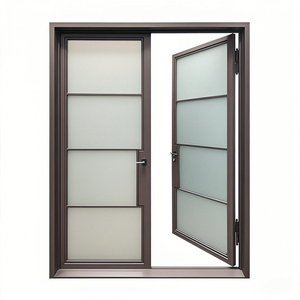
In the hierarchy of building envelope fenestration, aluminium casement doors represent the foremost threshold standard for acoustic dampening, environmental airtightness, and resistance to cyclical wind pressure. Unlike conventional horizontal sliding systems—which fundamentally depend on sacrificial mohair pile weather-stripping vulnerable to air filtration and water capillary bypass—a commercial-grade aluminium casement door operates on an active mechanical compression compression plane. When the multi-point kinetic locking gear is actuated, the entire door sash perimeter engages continuously against co-extruded EPDM or silicone hollow-bulb compression gaskets, achieving an airtight hermetic seal across all four frame quadrants.
For international developers procuring from China wholesale aluminium casement door factories, metallurgical integrity forms the foundation of structural durability. Leading manufacturers like Guangdong Dejiyoupin Doors and Windows Co., Ltd. (DERCHI) exclusively employ primary 6063-T5 or 6063-T6 architectural-grade aluminum alloy billets. These alloys exhibit an ultimate tensile strength exceeding 205 MPa and a yield strength exceeding 160 MPa. This metallurgical purity guarantees that even when tall sashes (reaching heights of 3000mm or beyond) are subjected to severe coastal wind loads or seismic shear, sash deflection remains strictly within the structural threshold of L/175 or L/250, preventing structural glass failure or permanent frame deformation.
Technical Insight: Specifying aluminium casement doors with wall thicknesses below 2.0mm in exterior residential configurations poses severe long-term risks. High-tier commercial installations require sash extrusion thicknesses of 2.0mm to 3.0mm to accommodate high-mass triple-glazed insulated glass units (IGUs) weighing upwards of 120 kg per leaf without hinge sagging or corner mitre rupture.
2. Advanced Thermal Barrier Science: Polyamide Technoform vs. Cast-in-Place Resin
As global energy efficiency regulations tighten—spanning from California's Title 24 and the International Energy Conservation Code (IECC) to European Passivhaus certifications—thermal bridge mitigation has become non-negotiable. Leading Chinese suppliers have phased out low-performance "pour-and-debridge" polyurethane resins in favor of mechanical roll-crimped Polyamide (PA66 GF25) thermal barrier strips. Reinforced with 25% chopped structural glass fibers, PA66 strips mirror the linear coefficient of thermal expansion of aluminum alloy profiles (2.3 × 10⁻⁵ /K), permanently eliminating thermal stress delamination, differential expansion cracking, and bowing under extreme indoor-outdoor thermal gradients.
When combined with multi-chamber profile extrusions, multi-stage warm-edge TGI spacers, and low-emissivity (Low-E) double or triple IGU packages filled with 90% dry argon gas, modern Chinese aluminium casement doors reliably achieve entire fenestration system U-values as low as 1.1 to 1.4 W/(m²·K) (or 0.19 to 0.24 BTU/h·ft²·°F). This exceptional thermal isolation slashes commercial HVAC life-cycle costs, eliminates condensation accumulation in high-humidity climates, and earns critical credits toward LEED and BREEAM building certifications.
| System Parameter | Standard Commercial Grade | DERCHI Architectural Heavy-Duty | Performance Impact |
|---|---|---|---|
| Alloy Metallurgy | Recycled 6063-T5 (1.4mm-1.6mm) | Virgin Billet 6063-T6 (2.0mm-3.0mm) | +45% Tensile Rigidity Zero corner sag under load |
| Thermal Break Strip | Standard PVC or 14.8mm PA66 | 24mm - 34mm Multichamber PA66 GF25 | U-Value < 1.2 W/m²K Complete thermal bridge separation |
| Perimeter Weatherseals | Single EPDM Sponge Strip | Triple Continuous Vulcanized EPDM Gaskets | Class 4 Air Tightness Zero wind-driven rain penetration |
| Locking Mechanism | Single or 2-Point Cam Latches | German Heavy-Duty 4-Point to 6-Point Gear | PAS 24 / RC3 Security Forced-entry anti-pry deterrence |
| Surface Coating | Standard Anodized / Thin PE Powder | Qualicoat Class 2 / PVDF 3-Coat 30-Year | ASTM B117 > 3000h Impervious to marine salt spray |
3. Product Development Trends: Minimalist Aesthetics, Smart IoT, and Hurricane Armor
The global market for wholesale aluminium casement doors is experiencing rapid technological evolution driven by three distinct architectural forces:
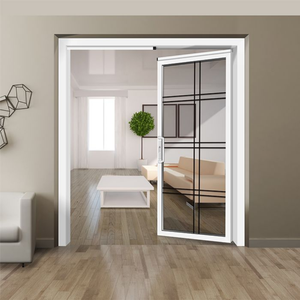
First, the ascendancy of ultra-narrow visual profiles. Architects increasingly reject bulky aluminum framing in favor of unobstructed glass panoramas. The current cutting-edge standard is typified by slim-profile systems like the RG50 series and minimalist Crittall-inspired heritage steel-look doors. By utilizing internal structural webs, high-moment-of-inertia reinforcement alloys, and high-performance structural silicone glazing (SSG), Chinese factories produce casement profiles with visible sightlines as narrow as 25mm to 38mm that retain full commercial deflection resistance.
Second, kinetic smart access integration. Enterprise buyers are shifting from standalone mechanical mortise locks toward concealed electronic multi-point lock systems. Casement doors now leave China OEM facilities pre-wired for biometric fingerprint sensors, micro-motor shoot-bolt drives, face-recognition modules, and building management system (BMS) dry contacts, all seamlessly hidden inside the thermal break profile cavity.
Third, severe meteorological resilience. With escalating cyclonic frequency worldwide, hurricane impact-rated fenestration has expanded far beyond Florida. Products certified under ASTM E1886/E1996 and Miami-Dade protocols now represent a massive export segment. Incorporating laminated architectural glass constructed with high-tensile ionoplast interlayers (Kuraray SentryGlas® Plus) and mechanically fastened heavy-duty continuous hinges, these impact casement doors comfortably survive 9-pound missile impacts at 50 feet per second, followed by 9,000 positive and negative cyclical pressure cycles.
