Commercial Grade
Explore our flagship OEM/ODM manufactured fenestration lines, engineered to satisfy extreme wind-load resistance, acoustic suppression, thermal efficiency, and refined aesthetic demands.
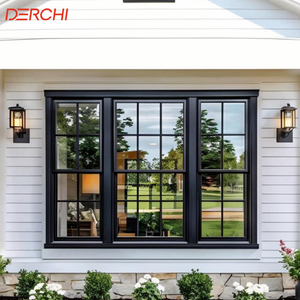
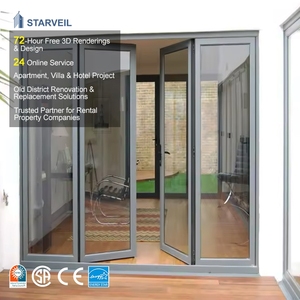
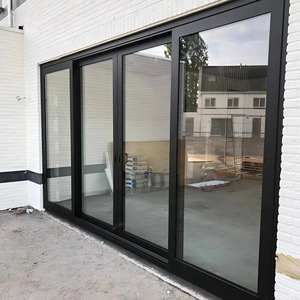
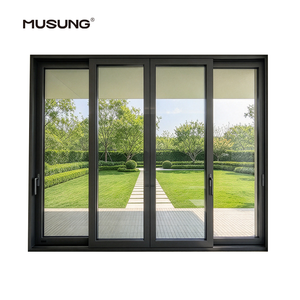
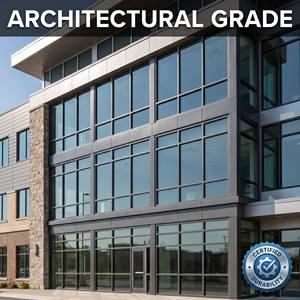
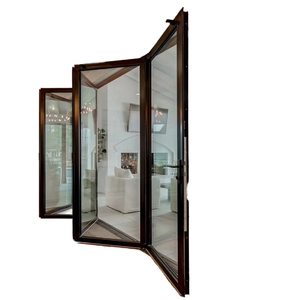
Bi-fold window systems operate under severe dynamic loads compared to fixed or conventional casement frames. Examine the critical mechanical criteria that differentiate residential fenestration from heavy commercial bifold systems.
Industrial folding windows demand virgin architectural aluminium 6063-T5 or structural 6063-T6 with uniform profile wall thickness between 1.8mm and 2.5mm. Inferior suppliers frequently utilize recycled billets with elevated iron impurities, provoking intergranular corrosion and rail deflection when supporting heavy laminated glass panels over 40kg per sash.
Energy-code compliant bifold windows incorporate dual extruded PA66 GF25 (25% glass-fiber reinforced polyamide) thermal break strips. This continuous physical barrier decouples exterior and interior extrusion chambers, reducing window thermal transmittance to achieve U-values as low as 1.4 W/(m²·K) when paired with Argon-filled Low-E insulating glass units.
The lifespan of a folding window is directly dictated by its top-hung guide bearings and bottom weight-bearing bogies. Leading OEM factories utilize SUS304 or SUS316 precision quad-roller assemblies with sealed synthetic nylon or polyoxymethylene (POM) wheels, rated for over 100,000 continuous operation cycles without track deformation or axial drop.
A cross-comparison matrix delineating baseline market benchmarks versus DERCHI's certified industrial export standards for high-span folding fenestration.
| Performance Parameter | Standard Market Offering | DERCHI Heavy-Duty OEM/ODM Grade | Compliance Test Standard |
|---|---|---|---|
| Alloy Metallurgy | Recycled 6063-T5 (1.4mm – 1.6mm) | Primary Ingot 6063-T6 (2.0mm – 2.5mm) | GB 5237 / ASTM B221 |
| Wind Pressure Resistance | Class 4 (±2000 Pa) | Class 9 (>5000 Pa) / Cyclone Rated N6 | AS 2047 / ASTM E330 |
| Water Penetration Resistance | 250 Pa – 350 Pa (Unshielded) | 600 Pa – 900 Pa with Weep Dam Valve | EN 12208 / AS 4420.4 |
| Air Permeability | Level 4 (≤1.5 m³/(m·h)) | Level 8 (≤0.5 m³/(m·h)) Dual EPDM | EN 12207 / AAMA 501 |
| Acoustic Attenuation | Rw = 28 dB to 32 dB | Rw = 38 dB to 44 dB (Acoustic PVB) | ISO 10140-2 / ASTM E90 |
| Cycle Operational Life | 20,000 Open/Close Cycles | 100,000+ Cycles (SUS316 Quad Rollers) | EN 13126-15 / AAMA 910 |
| Surface Treatment Resilience | Standard Anodized (10-15 μm) | Fluorocarbon PVDF (≥40 μm) / AkzoNobel | AAMA 2605 / Qualicoat Class 2 |
How stringent ESG standards, minimalist architecture, and smart building interfaces are reshaping the B2B supply chain for commercial and luxury residential fenestration through 2030.
Architects are aggressively rejecting chunky profile perimeter margins. Next-generation bifold windows leverage high-moment-of-inertia profiles that enable mullion widths under 45mm while completely concealing hinge barrels and carrier guide pins within the extrusion channel for a seamless panoramic aesthetic.
With global green building protocols (LEED v4.1, BREEAM, and Germany's Passivhaus standard) enforcing stringent building envelope coefficients, folding window assemblies are migrating toward triple-glazed, argon-injected insulated units (IGUs) with Warm-Edge composite spacers, achieving overall window Uw ≤ 1.0 W/(m²·K).
Universal accessibility and indoor-outdoor continuity have made zero-step transitions mandatory. Advanced OEM engineering now supplies flush-recessed drainage sills with self-contained siphon conduits and one-way gravity backflow valves, ensuring zero water backflow during 100mm/hr cloudbursts without tripping hazards.
Oversized commercial servery windows and hospitality folding partitions are integrating internal brushless DC servo motors. Sashes can be folded back effortlessly via wall switches, smart home gateways, or building management systems (BMS) with pinch-detection sensors and automatic rain-closing automation.
How Guangdong's premier fabrication facilities are replacing traditional craft fabrication with robotic tolerances and aerospace-grade surface finishing.
Manual notch punching is obsolete. Direct factory production now implements automated German 5-axis CNC machining centers. Profiles are routed, drilled, and slotted in a single clamping setup with dimensional tolerances within ±0.1mm, ensuring hinge seating precision and 100% airtight sash-to-frame alignment across 8-panel configurations.
Air and water leakage routinely occur at the 90-degree corner joints of traditional cut rubber gaskets. Premier manufacturers incorporate injection-molded continuous vulcanized EPDM corner blocks, maintaining uniform compression seal pressure across temperature variations ranging from -40°C to +85°C without gasket shrinkage.
Coastal and high-UV commercial installations require specialized finishes. Utilizing electrostatic vertical spraying lines, extrusions are treated with genuine AkzoNobel Interpon D2525 or fluorocarbon PVDF finishes that survive 3,000-hour accelerated salt spray testing (ASTM B117) with zero chalking, blistering, or color shifts over decades.
Operating within Foshan, China's world-leading aluminium extrusion and hardware manufacturing cluster, Guangdong Dejiyoupin Doors and Windows Co., Ltd. (DERCHI) delivers vertically integrated fabrication power to world-class construction initiatives.
With an expansive 180,000m² production complex staffed by over 600 veteran technicians, our monthly extrusion and fenestration output exceeds 45,000 square meters. We control the complete process from precision profile cutting and thermal-break assembly to automated IGU insulating glass fabrication and pre-shipment mock-up trials.
We supply verifiable third-party engineering compliance documentation, including CE (EN 14351-1), ISO 9001 quality management, Australian AS 2047 (with N6 cyclone impact testing), and North American UL fire door certifications. Our factory holds over 100 technology, utility, and appearance design patents.
Our dedicated bilingual engineering division collaborates directly with developers, architects, and quantity surveyors. We produce detailed Revit BIM objects, 2D shop drawings, structural wind-load windward/leeward calculations, and thermal modeling within 48 hours of initial tender review, preventing site fitment errors.
Authoritative technical answers addressing commercial MOQ, structural engineering, sea-freight logistics, and field installation for international project buyers.
Submit your fenestration schedule, CAD drawings, or custom OEM/ODM dimensional parameters. Our structural engineers provide comprehensive wind load analysis, U-value calculations, and competitive FOB/CIF shipping quotations within 24 hours.