Certified Aluminium Safety Door Systems & Fenestration Arrays
Precision architectural doors and impact systems manufactured using primary billet aluminium, multiaxial safety locking hardware, and high-performance weatherization gaskets.
Global Procurement Analysis: Top 10 Aluminium Safety Door Supplier Standards
When selecting premier suppliers within the global aluminium safety door sector, engineering consultants, procurement directors, and tier-one developers look beyond superficial catalog designs. Industrial aluminium safety doors serve as the core perimeter envelope barrier for high-end residential villas, commercial high-density compounds, coastal hotel projects, and secure institutions. Establishing parity among top international suppliers requires an evaluation based on alloy integrity, structural deflection under uniform static wind loads, cyclic intrusion resistance, thermal bridge disruption, and metallurgical corrosion countermeasures.
Top-tier manufacturing facilities located within leading industrial fabrication clusters—such as the Nanhai District in Foshan, China—integrate primary smelting billet processing, vertical automated powder-coating lines, and CNC four-axis machining centers. These systems maintain strict fabrication tolerances within ±0.5 mm across complex multi-leaf spans, eliminating the air infiltration and latch misalignments that frequently compromise secondary market fabrications.
| Evaluation Parameter | Commercial Grade Door Systems | Tier-1 Aluminium Safety Door Assemblies | Impact / Critical Compliance Spec |
|---|---|---|---|
| Primary Structural Alloy | Recycled / Secondary 6063 Scrap | Primary Billet Al-Mg-Si (6063-T5 / 6061-T6) | High-Tensile Yield Strength ≥ 160 MPa |
| Intrusion & Forced Entry | Single-point deadbolt latch | 5 to 7-point gear-driven perimeter locking | EN 1627 RC3/RC4 & PAS 24 Approved |
| Acoustic & Thermal Insulation | Hollow profile, air bridge path | Polyamide PA66 GF25 thermal barrier strut | U-factor ≤ 1.4 W/m²·K; STC rating ≥ 38 dB |
| Gasket Compression Profile | Standard PVC strip extrusion | Continuous cellular vulcanized EPDM | ASTM E283 & E331 Zero Infiltration |
| Finishing & Salt-Spray Armor | Standard electrostatic dip ≤ 40μm | PVDF fluorocarbon / AkzoNobel powder > 80μm | AAMA 2605 compliant, 3000-hr salt spray |
Engineering teams analyzing high-volume procurement schedules identify significant differences between entry-level suppliers and top-rated industrial fabricators. The critical factor lies in systematic lifecycle durability: the hinge leaf load capacities, pivot balance stability for oversized sashes exceeding 400 kg, and integration of anti-saw, anti-pry hardened steel internal core reinforcement. Supplying international projects across North America, Australia, the Middle East, and South Asia requires certified verification of these metrics.
Architectural Engineering Insights: Advanced Material Dynamics & Intrusion Defense
The transition from conventional mild steel and solid timber toward architectural aluminium safety assemblies is driven by physical properties and long-term durability. While timber doors swell, twist, and delaminate in monsoon-heavy, high-humidity regions, and steel entryways face galvanic oxidation in marine microclimates, structural aluminium alloy provides consistent dimensional stability. When treated with PVDF or fluorocarbon electrostatic coatings, structural aluminium creates a self-passivating boundary layer that resists corrosive chloride ions.
Multi-Point Deadlock Kinetic Arrest
Concealed gear transmission boxes activate multi-point stainless steel hooks along the vertical and horizontal frame channels, distributing localized pry-bar force across the full structural jamb.
Polyamide Structural Thermal Breaks
PA66 GF25 (25% glass fiber reinforced polyamide) mechanical barriers isolate internal and external aluminium profiles, preventing heat transfer and interior condensation build-up.
Impact Laminated Glazing Interlayers
Double and triple-glazed units utilize structural SentryGlas (SGP) or high-density PVB interlayers bonded to heat-strengthened glass panels to withstand extreme pressure and cyclic impacts.
Cyclic Stress Mitigation in Oversized Pivot & Bi-Fold Geometries
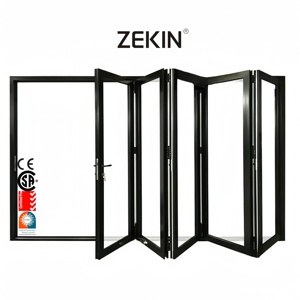
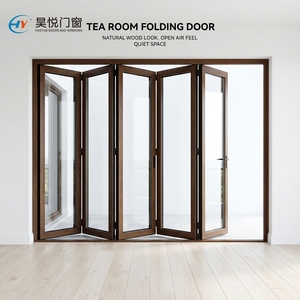
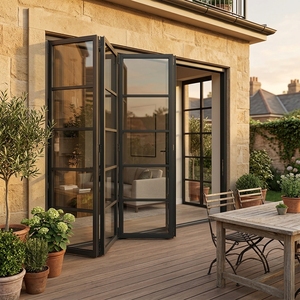
Modern architectural trends favor expansive glass entries, wide-span bi-folds, and high-clearance pivot doors. Sashes exceeding 1.5 meters in width and 3.2 meters in height place sustained torsional force on top and bottom hinge pins. Leading manufacturers prevent sagging and hinge failure by incorporating internal corner joints anchored with double-pinned cast aluminium corner brackets, secured using structural two-component epoxy bonding agents.
Pivot entry assemblies are engineered with bottom bearings rated for commercial dynamic loads up to 600 kg. These heavy-duty mechanisms include internal damping cylinders that absorb sudden wind gusts, protecting the structural frame and surrounding masonry from impact damage.
Future Sourcing & Technology Trends in Aluminium Door Systems (2025–2030)
Large-scale architectural procurement requires visibility into emerging material specifications, building energy directives, and digital security integrations. Major procurement pipelines are aligning with several core technological shifts:
1. Automated Smart Access Architecture & Invisible Integration
Mechanical keys are increasingly being replaced by integrated mechatronic mortise locks. High-security residential and commercial installations now standardise on 3D structured-light facial recognition, hidden capacitive biometric touchpoints, and encrypted digital protocols (Zigbee, Matter, and Apple HomeKit). These components are engineered directly into the extrusion channels, maintaining sleek door aesthetics without external battery packs or awkward surface wiring.
2. Low-Carbon Billet Extrusion & Supply Chain Traceability
With environmental reporting and green building standards (LEED, BREEAM, and the EU Carbon Border Adjustment Mechanism) gaining traction, international real estate developers require documented embodied-carbon ratings. Leading aluminium safety door fabricators are transitioning to smelters powered by renewable hydroelectric energy, verifying that virgin billet processing produces less than 4.0 kg CO&sub2; per kg of finished metal.
3. Extreme Climate, Cyclone, and Coastal Resilience Formulations
Changing global weather patterns have driven broader demand for AS 2047 cyclonic impact ratings and Miami-Dade Florida Building Code compliance across coastal regions. Sourcing teams are shifting away from standard residential configurations toward door frames tested to resist sustained positive and negative structural wind pressures up to 4500 Pa, combined with continuous sill water drainage systems that prevent internal water intrusion during severe storms.
DERCHI Enterprise Capabilities: Foshan Manufacturing Authority
Operating from Foshan, Guangdong—the epicenter of global performance door and window manufacturing—Guangdong Dejiyoupin Doors and Windows Co., Ltd. (DERCHI) delivers end-to-end engineering and production support for high-end residential, commercial, and mixed-use development projects globally.
180,000 m² Automated Manufacturing Hub
Equipped with computerized high-precision extrusion cut-off centers, continuous assembly lines, and specialized testing labs to fulfill large-scale, custom-dimension commercial orders.
Global Testing & Certified Approvals
Manufactured to meet ISO 9001 quality systems and tested against international structural codes including CE, AS 2047, NFRC, and UL fire door assembly standards.
Full CAD/BIM Parametric Shop Drawings
Our dedicated structural engineering team provides complete technical drawings, wind load calculations, and anchorage details tailored to exact site conditions and regional architectural drawings.
By managing every stage in-house—from raw billet extrusion through CNC corner milling, surface treatment, multi-layer marine-grade crating, and global freight support—DERCHI eliminates middleman costs and delivers verified, code-compliant door assemblies directly to project job sites worldwide.