High-Performance Architectural Fenestration Systems
Precision-engineered extruded aluminum windows and architectural entry assemblies manufactured in Foshan under strict ISO 9001 and international building envelope compliance protocols.
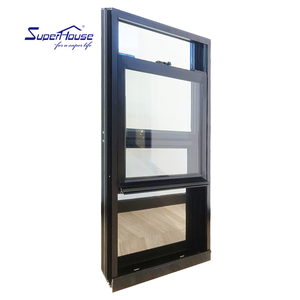
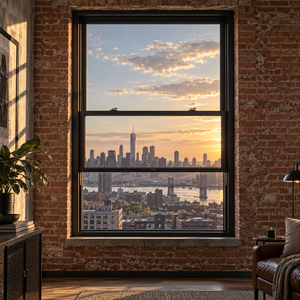
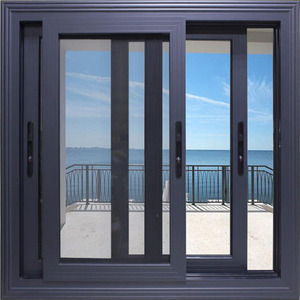
The Technical Shift in Modern Architectural Aluminum Fenestration
In contemporary building envelope engineering, specifying aluminum around windows and exterior glazed openings is no longer merely an aesthetic selection. Structural engineers, facade consultants, and general contractors now benchmark manufacturing partners against stringent thermodynamic thresholds, deflection tolerances under cyclic wind loading, and metallurgical integrity.
The global fenestration supply chain has shifted significantly away from non-insulated standard profiles toward multi-cavity, polyamide-insulated thermal break extrusions. When selecting among the top 10 aluminum around windows factory and exporter partners, procurement directors must analyze not only gross factory output, but specifically the chemical composition of primary billet ingots (A6063-T5 vs. T6), automated corner-crimping methodologies, and verified acoustic attenuation capabilities.

Top 10 Engineering Benchmarks for Premier Aluminum Window Exporters
How commercial developers, Tier-1 builders, and architectural specifiers evaluate and rank premier aluminum fenestration exporters to mitigate structural failure and transit delays.
01. Primary Billet Purity & Wall Thickness
Top-tier factories refuse scrap aluminum, extruding exclusively from virgin 6063 or 6060 aluminum billets with strict magnesium and silicon controls. Outer wall profiles must maintain nominal thickness ≥1.4mm for windows and ≥2.0mm for heavy commercial sliding/folding doors.
Tensile Strength: ≥ 205 MPa02. Thermal Separation Architecture
Inferior PVC isolators warp under high solar load. Leading exporters utilize glass-fiber reinforced polyamide strips (Technoform PA66 GF25) mechanically rolled into knurled extrusion teeth, preventing thermal bridging and surface condensation under extreme ΔT conditions.
Insulation: PA66 GF25 Strip03. Hydraulic Corner Crimping Integrity
Screw-connected miter joints frequently open over time, causing structural leaks. Elite manufacturers deploy automated hydraulic punch crimping with cast-aluminum interior corner keys and continuous two-component epoxy injection for seamless, hermetically sealed joints.
Automated Dual-Part PU Injection04. Multi-Chamber Pressure Equalization
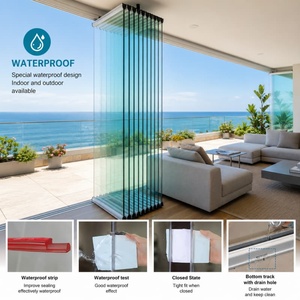
To stop driving rain during monsoons and coastal storms, window systems must embody the rain-screen principle. Internal drainage paths, offset weep slots with anti-backflow baffles, and triple-tier continuous EPDM perimeter gaskets prevent internal hydrostatic water ingress.
Water Tightness ≥ 450 Pa05. Automated IGU Double/Triple Glazing
Automated desiccant filling, warm-edge composite spacers (Swisspacer), and secondary polysulfide/structural silicone seals prevent premature argon depletion. Exporters must supply laminated, tempered, and low-E coatings customized to local solar heat gain requirements.
Argon Gas Retention ≥ 90%06. Marine-Grade Surface Treatment
Coastal salt spray and intense UV degrade standard coatings within 24 months. Factories must provide certified AAMA 2605 fluorocarbon (PVDF) three-coat finishes or Qualicoat Class 2 architectural powder coats, tested through 3,000+ hours of continuous neutral salt spray.
Salt Spray Resistance: ≥ 3,000 Hrs07. Heavy-Duty European Hardware Fitment
Sash sag and premature gasket collapse stem from substandard hinge gear. Elite exporters partner with Tier-1 architectural hardware makers (Siegenia, Roto Frank, Hoppe, or proprietary precision bearings) rated for 50,000+ continuous full-load operating cycles.
Cycle Rating: ≥ 50,000 Oper08. Third-Party Code Accreditation
Reliable international exporters maintain physical testing reports rather than unsubstantiated claims. Mandatory export benchmarks include Australian AS2047 (wind deflection, air leakage, water barrier), American NFRC/AAMA ratings, and European CE EN 14351-1 declarations.
AS2047 N6 · NFRC · CE Certified09. In-House CAD/BIM Custom Engineering
Bespoke luxury residential and commercial developments require non-standard structural mullions, curtain wall transoms, and expansion jamb adaptors. Leading manufacturers operate dedicated engineering teams providing shop drawings and full BIM Revit object models.
Full Shop CAD & Revit BIM10. Heavy-Duty Ocean Export Crating & Nitrogen Desiccant Packaging
Even the finest precision fenestration fails if glass shatters or frames rack during 30-day ocean voyages. Exemplary Chinese factories utilize fully enclosed, ISPM-15 compliant plywood crates with steel angle corner reinforcements, protective PE film wrap, non-marking rubber spacers, and silica gel moisture buffers to withstand rough port transshipment.
ISPM-15 Certified Steel-Crated Freight PackagingComparative Engineering Specifications: Standard vs. Architectural Grade
Detailed comparison between local low-cost generic aluminum windows and export-grade thermal break fenestration manufactured for extreme climatic exposure.
| Evaluation Parameter | Generic Commodity Window | DERCHI Architectural Grade (Export Standard) | Structural Compliance Impact |
|---|---|---|---|
| Billet Alloy & Temper | Recycled Mixed Scrap Billet | 6063-T5 / 6063-T6 Pure Primary Ingot | Prevents brittle micro-cracking under seismic load |
| Frame Profile Thickness | 0.8 mm – 1.1 mm (Sub-standard) | 1.4 mm – 2.2 mm (Heavy Wall Section) | Exceeds AS2047 structural deflection limits |
| Thermal Barrier Method | None or Thin PVC Strips | Polyamide PA66 GF25 Multi-Chamber Strip | Reduces U-Value from 5.8 down to 1.4 W/m²K |
| Corner Joint Construction | Self-Tapping Dry Screw Joint | Hydraulic Crimp + Dual Epoxy Injection | Eliminates diagonal sash drop & corner water weeping |
| Glass Configuration | 5mm Single Clear Float Glass | 5mm+12A+5mm Low-E Tempered Argon Double Glazed | Improves acoustic STC up to 38-42 dB |
| Surface Protection | Standard Mill / Basic Powder Coat (30μm) | AAMA 2605 PVDF / Qualicoat Class 2 (70-90μm) | Immunity to chalking, peeling & ocean marine salinity |
| Cyclonic Wind Rating | < 1500 Pa (Prone to blowout) | AS2047 N6 Class (> 4500 Pa Ultimate Pressure) | Approved for coastal typhoon & hurricane pathways |
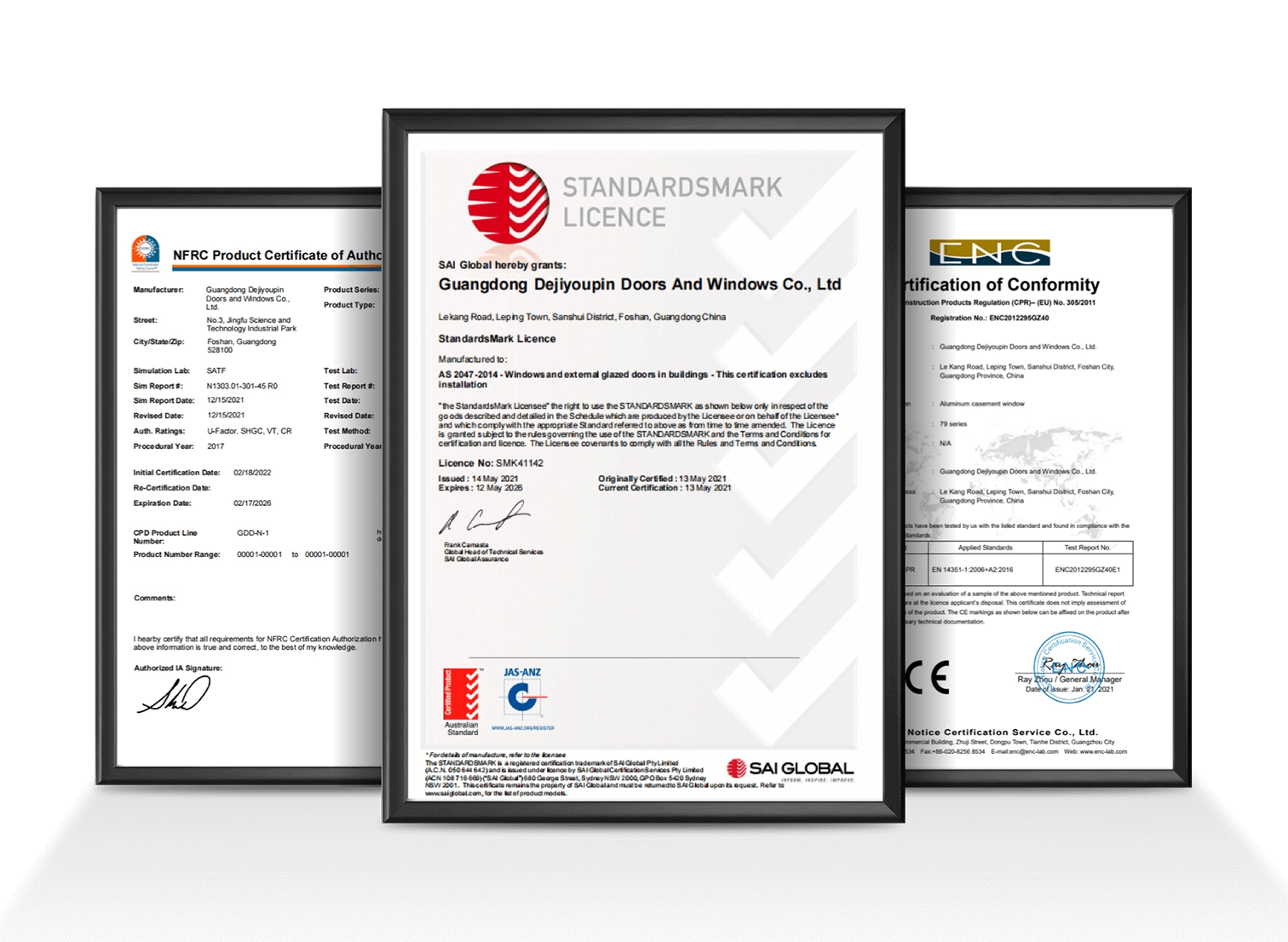
Guangdong Dejiyoupin (DERCHI): Foshan’s Fenestration Benchmark
Rooted in Shishan Town, Nanhai District, Foshan—the global epicentre of high-precision aluminum extrusion—Guangdong Dejiyoupin Doors and Windows Co., Ltd. (DERCHI) represents over 25 years of engineering mastery in premium architectural openings.
Spanning an integrated 180,000 square meter industrial base with over 600 specialized workers, DERCHI is formally acknowledged among China's Top 10 fenestration manufacturers. Rather than relying on commercial intermediaries, global importers and developers communicate directly with in-house structural engineers to execute bespoke shop drawings, BIM schedules, and containerized logistics to North America, Australia, Europe, and the Middle East.

End-to-End In-House R&D
From billet extrusion modeling to acoustic testing bays, every window profile undergoes finite element analysis (FEA) to confirm wind pressure and condensation performance before tooling fabrication.
30+ Proprietary PatentsGlobal Project Portfolio
Proven delivery across demanding international building environments: high-rise towers in the United States and Canada, beachfront luxury estates in Australia, and hurricane-resilient resorts in the Philippines.
Over 65 Export DestinationsDedicated Bilingual Engineers
Overcome communication gaps with professional English-speaking fenestration project managers. Free custom CAD take-offs, glass U-value calculations, and real-time video factory audits via VR link.
Instant CAD Take-Off ResponseFuture Procurement Trends in Architectural Fenestration
Critical technological advancements and legislative shifts shaping global window and door procurement strategies over the next decade.
Decarbonization & EU CBAM Carbon Tariffs
With the European Union implementing the Carbon Border Adjustment Mechanism (CBAM) and North America expanding LEED v4.1 requirements, global buyers are auditing the embodied carbon of aluminum extrusions. Forward-thinking exporters are adopting low-carbon billets smelted with renewable hydro energy, achieving certified Environmental Product Declarations (EPD) with carbon footprints under 4.0 kg CO₂ per kg of aluminum.
CBAM Compliant Low-Carbon SmeltingMinimalist Sightlines with Structural Glass Bonding
Architectural demand has shifted decisively toward panoramic, uninterrupted vistas. Next-generation systems feature ultra-slim interlocks (≤ 20mm sightlines) where structural silicone bonding transfers wind loads directly from the glass panel to heavy-duty concealed perimeter frames, allowing ceiling-to-floor panels exceeding 6.0 meters in height.
Slim-Sightline Structural GlazingUnitized Window-Wall Prefabrication
Skyrocketing on-site union labor costs in target markets (North America, UK, Australia) are accelerating the transition from stick-built window installations to fully unitized, factory-glazed window-wall cassettes. Prefabricated floor-by-floor assemblies with integrated slab-edge perimeter covers reduce project installation schedules by up to 60%.
Accelerated Jobsite InstallationSmart Automated Envelopes & Dynamic Glazing
High-performance fenestration is integrating directly with Building Management Systems (BMS). Hidden 24V brushless motorized sash actuators, biometric multi-point smart deadbolts, and electrochromic glass panes that adjust solar heat gain (SHGC) dynamically based on rooftop solar pyranometer readings are becoming baseline specifications.
Smart BMS Actuator IntegrationFrequently Asked Questions by Commercial Buyers & Specifiers
Direct technical answers addressing the real engineering, logistic, and code compliance queries encountered when importing architectural aluminum windows from China.
What is the structural difference between standard aluminum and thermal-break aluminum profiles?
How does Australian AS2047 compliance differ from American NFRC/AAMA or European CE standards?
Why is corner-crimp assembly superior to traditional mechanical screw-fastened joints?
What glass configuration is recommended for coastal, high-humidity, or hurricane-prone environments?
How does DERCHI ensure containerized ocean freight arrives with zero oxidation or breakage?
What is the standard production lead time for custom architectural aluminum window orders?
Accelerate Your Project with Certified Fenestration Engineering
Direct factory pricing, custom CAD shop drawings within 24 hours, and guaranteed compliance testing reports for architects, developers, and distributors worldwide.