Global Fenestration & Façade Technical Whitepaper

Top 10 Aluminum Entry Door Factory & Exporters

A Comprehensive B2B Sourcing Analysis, Metallurgical Performance Guide, and Engineering Procurement Blueprint for Architectural Projects Worldwide.

Industry Whitepaper Report

The Global Shift in Aluminum Entry Door Manufacturing & Export Hubs

As modern architectural design evolves toward floor-to-ceiling fenestration, oversized monumental pivot doors, and aggressive building envelope thermal targets (Passivhaus and ASHRAE 90.1), the global supply chain for aluminum entry doors has undergone a seismic relocation.

Historically, bespoke aluminum entry doors and thermal barrier systems were monopolized by central European fabricators in Germany, Switzerland, and Northern Italy. However, over the past decade, high capital expenditure in automated 5-axis CNC extrusion machining, automated powder coating plants adhering to Qualicoat Class 2 / AAMA 2605 certifications, and vertical supply-chain integration have turned China's Pearl River Delta—specifically Foshan, Guangdong—into the primary manufacturing nexus for global developers, architects, and direct commercial importers.

Today's B2B buyers no longer compromise between bespoke craftsmanship and production capacity. Premier factories provide full parametric CAD/BIM shop drawings, custom extrusion alloys (such as primary billet 6063-T6), concealed European multi-point security hardware, and international performance certifications—all delivered at a 35% to 50% cost advantage compared to domestic fabricators in North America, Australia, or Western Europe.

Comparative Benchmark Matrix: Top 10 Aluminum Entry Door Manufacturing Tiers

Tier / Manufacturing Origin Core Extrusion Alloys Thermal Break Technology Surface Treatment Standard Standard Lead Time Direct Sourcing Cost Margin
Tier 1: Foshan Integrated Hubs (DERCHI) 6063-T5 / 6063-T6 Primary Billet PA66 GF25 Polyamide (24-34mm) PVDF Fluorocarbon / Qualicoat Cl. 2 20 – 30 Days Optimal Direct Factory Baseline
Tier 2: German & Swiss System Fabricators AlMgSi0.5 (DIN 1748) Multi-Chamber Technoform Polyamide Anodized 20-25µm / DIN 50021 60 – 90 Days +120% to +180% Premium
Tier 3: North American Regional Assemblers 6063-T5 / Recycled Aluminum Poured & Debridged Urethane / PA66 AAMA 2604 Standard Powder Coat 45 – 70 Days +85% to +140% Premium
Tier 4: Polish & Eastern European Exporters 6060 / 6063-T6 Extrusions Polyamide Insulating Struts Qualicoat Standard Powder Coat 35 – 50 Days +45% to +70% Margin
Tier 5: Turkish Mediterranean Fabricators Secondary Recycled Alloys Standard PVC or 14mm Polyamide Electrostatic Standard Coating 25 – 40 Days +10% to +25% Margin

Selecting an exporter requires navigating past simple middleman trade agencies. Enterprise buyers evaluate extrusion wall thickness (minimum 2.0mm to 3.0mm structural webs for pivot doors), certified alloy tensile ratings, third-party air/water/wind pressure reports (such as AS 2047 N6 or ASTM E330), and documented salt-spray corrosion resistance.
Procuring Custom Aluminum Entry Doors for Upcoming Projects?

Connect immediately with DERCHI’s senior façade engineers for structural load calculations, custom extrusion CAD submittals, and factory-direct FOB/CIF estimates within 24 hours.

Engineering Whitepaper

Material Science: What Separates Industrial-Grade Doors from Commodity Products

A breakdown of metallurgical integrity, thermal boundary engineering, and security hardware architectures required for institutional longevity.

Primary Billet 6063-T6 Extrusion

Unlike lower-tier manufacturers utilizing scrap remelt alloy contaminated with excess iron, premier factories utilize 100% primary ingot 6063 aluminum artificial aged to T6 temper. This delivers yield strengths exceeding 214 MPa and ultimate tensile strengths of 241 MPa, ensuring colossal pivot panels up to 4.5 meters in height resist wind load deflection without structural fatigue.

Polyamide PA66 GF25 Thermal Barriers

Aluminum is naturally conductive ($K \approx 160\text{–}200\text{ W/m}\cdot\text{K}$). Top-tier thermal break systems mechanically crimp 24mm to 34mm wide Polyamide 6.6 reinforced with 25% glass fiber between exterior and interior extrusion chambers. This coefficient of thermal expansion matches the metal exactly, preventing delamination and dropping door U-values below $1.2\text{ W/m}^2\cdot\text{K}$.

Anti-Pry Multipoint Lock Systems

Entry doors in high-security villas and hotels demand multi-point locking mechanisms (KFV, Siegenia, or custom proprietary gearboxes). Engaging 3 to 7 stainless steel roller cams, deadbolts, and hook bolts along the full perimeter frame prevents jemmying attacks, balances gasket compression against heavy storm rain, and guarantees air-leakage compliance under high negative pressures.

Surface Finishing: PVDF Fluorocarbon vs. Qualicoat Class 2 Powder Coating

Exterior aluminum entrance systems endure relentless UV radiation, acid rain, and coastal salt spray. High-performance factories employ automated pre-treatment baths (zirconium chemical conversion rather than obsolete chromating) followed by electrostatic electrostatic coating.

For projects within 3 miles of open ocean (e.g., coastal villas in Florida, the Caribbean, Dubai, Mumbai, or Sydney), top exporters mandate either AAMA 2605-compliant PVDF coatings (70% Kynar 500 resins) or Qualicoat Class 2 hyper-durable polyesters. These formulations resist 3,000+ hours of continuous neutral salt-spray (ASTM B117) and maintain gloss retention and color stability ($\Delta E < 5$) for over 20 years without chalking or micro-cracking.

Strategic Sourcing Intelligence

Future Trends in Aluminum Entry Door Architecture & Procurement

Critical product evolutions, sustainability standards, and technological integrations shaping global facade schedules over the next five years.

Colossal Architectural Pivot Systems

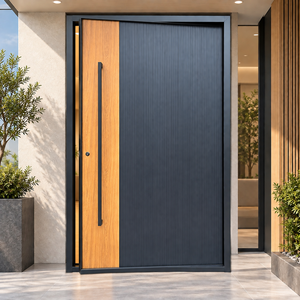
Traditional side-hung hinges are rapidly being superseded in high-end residential and hotel projects by floor-recessed German Dorma/FritsJurgens hydraulic pivot bearings. These systems accommodate leaf widths over 2,200mm, heights up to 5,000mm, and weights exceeding 600kg with effortless finger-touch movement and magnetic concealed perimeter draft drop seals.

IoT Smart Access & Biometric Integration

Modern entry portals now integrate seamless flush biometric touchpads, 3D facial recognition lenses, 24V motorized multi-point drive units, and encrypted wireless relays (supporting Matter, Zigbee, and KNX smart building protocols). The wiring conduits and power-transfer hinges are fully CNC-machined within the thermal cavity at the factory stage.

Circularity & Low Embodied Carbon

With LEED v4.1, BREEAM, and EU CBAM tariffs setting rigid carbon caps, enterprise developers demand Environmental Product Declarations (EPDs). Leading aluminum exporters are deploying hydro-powered low-carbon primary aluminum billets with embodied carbon emissions below 4.0 kg $\text{CO}_2$ per kg of aluminum, compared to the coal-fired industry average of 14.5 kg $\text{CO}_2$.

25+
Years Engineering Heritage
180,000m²
Intelligent Production Facility
600+
Technical Personnel & Masters
100+
Global Patents & Certifications
DERCHI Guangdong Dejiyoupin Manufacturing Center Aerial View

DERCHI Industrial Complex — Foshan, Guangdong

180,000 m² Automated Manufacturing Headquarters dedicated to global luxury entry systems.

Enterprise Distinction

Why Global Architects & Specifiers Select Guangdong Dejiyoupin (DERCHI)

Ranked firmly among China's premier fenestration and entrance door manufacturers, Guangdong Dejiyoupin Doors and Windows Co., Ltd. (DERCHI) operates an integrated industrial complex in Foshan engineered to bridge European structural performance standards with direct manufacturing agility.

  • Exhaustive International Certifications: Fully certified under CE, ISO 9001, AS 2047 (Pass N6 Cyclone ratings), NFRC thermal metrics, and UL fire-rated standards.
  • Precision CNC Tolerance Machining: Advanced 5-axis German CNC profile centers ensure precision corner joints (<0.1mm tolerance) and concealed drainage machining.
  • Full In-House BIM & CAD Submittals: Complimentary architectural shop drawing service tailored precisely to site structural openings, wind pressure codes, and local building traditions.
  • Heavy Export Crating & Freight Assurance: Triple-layer protection featuring PE film wrapping, high-density shock-absorbing corner pads, and IPPC-stamped fumigation-free timber export crates.
Procurement Clarity

Frequently Asked Questions for Sourcing Aluminum Entry Doors

Straightforward, technical answers addressing common engineering challenges, lead times, logistics, and quality assurance workflows.

? How do aluminum entry doors compare to solid teak or mahogany in tropical and monsoon regions?

Solid natural timber possesses hygroscopic properties, causing it to absorb atmospheric moisture during humid and monsoon conditions. This leads to swelling, warping, binding against the jamb, frame distortion, and vulnerability to subterranean termites. In contrast, heavy-wall aluminum alloy (6063-T6) combined with thermoset fluorocarbon or architectural powder finishes has zero water absorption, absolute termite immunity, and does not alter dimensional geometry under 100% relative humidity or extreme temperature swings from -20°C to +55°C.

? What structural criteria are needed to specify an oversized pivot door (e.g., 2000mm x 3500mm)?

Specifying oversized monumental pivots requires three critical engineering factors: First, the internal structural stile profiles must have a minimum wall thickness of 3.0mm with internal reinforced steel corner chevrons to resist wind torque. Second, the pivot system should utilize high-capacity bottom floor bearings (such as FritsJurgens System M+ or heavy-duty Dorma bearings) anchored directly into the structural slab to support up to 500kg–800kg loads. Third, the perimeter must integrate dual continuous EPDM compression seals and drop-down mechanical threshold gaskets to prevent air infiltration and water ingress under high positive wind pressures.

? What international testing standards must be verified before placing a commercial order?

Depending on your project location, verify the following: For North America, ASTM E283 (Air Leakage), ASTM E331 (Water Penetration), and ASTM E330 (Structural Transverse Load), as well as NFRC U-factor certification. For Australia and New Zealand, AS 2047 (mandatory windows and doors standard) with ratings up to N6 for cyclonic zones. For the European Union and the UK, CE marking conforming to EN 14351-1. DERCHI provides verified, accredited third-party test reports validating all pressure, thermal, and acoustic metrics.

? Can the doors be customized according to architectural drawings and Vastu / Feng Shui dimensional constraints?

Yes. Every entrance door system manufactured in our Foshan facility is 100% made to order. Our facade engineering department generates precise 2D CAD and 3D Revit shop drawings incorporating customized opening widths, heights, panel proportion rhythms, sidelite/transom configurations, swing or pivot geometries, and auspicious dimension thresholds aligned to Vastu or architectural grids prior to cutting the extrusion billets.

? What is the standard production lead time and export packaging process for container shipping?

Standard production lead time for bespoke thermal break entrance doors ranges between 20 to 30 business days following final CAD sign-off. For long-distance sea container transport (FOB or CIF terms), door slabs and frames are individually wrapped in 0.2mm anti-scratch PE film, protected with high-density EPE foam corner protectors, and sealed into structural, fully enclosed plywood crates (non-coniferous, ISPM 15 fumigation-free). This packing methodology guarantees zero transit movement, surface abrasion, or moisture ingress during multi-week oceanic freight.

Tender Preparation

Request a Technical Tender & Factory-Direct Quotation

To receive an accurate engineering quotation within 24 hours, ensure your inquiry submittal includes the following key project specifications.

Specification Parameter Recommended Project Information to Provide
Rough Opening (RO) Dimensions Finished width, height, and wall thickness (including threshold depth).
System Configuration Single swing, French double-swing, large architectural pivot, or integrated sidelite/transom.
Thermal & Glazing Target Non-thermal break or Polyamide PA66 break; single, double, or triple Low-E insulated tempered glass.
Hardware & Access Control Standard mechanical multi-point lock, concealed floor pivot spring, or biometric smart-lock integration.
Surface Finish & Color Qualicoat Class 2 architectural powder coat (RAL code), 70% PVDF finish, or 3D wood-grain sublimation.
Delivery Destination Project city and nearest international seaport for FOB, CIF, or DDP logistic calculations.
Send an Inquiry