Top China Aluminium Windows Prices, Manufacturers & Suppliers
Complete 2025–2026 Procurement Guide: Wholesale Factory Price Benchmarks, Architectural Extrusion Standards, N6 Wind-Load Engineering, and Direct Foshan Supply Chains.
Verified Architectural Systems
Featured Aluminium Windows & Architectural Door Systems
Direct factory production lines engineered to AS 2047, CE, and ISO 9001 standards. Tailored for commercial high-rises, passive low-energy villas, and luxury residential developments.
China Aluminium Windows Price Matrix & Cost Determinants
Wholesale pricing for architectural aluminium windows in China is determined by metric profile weight, extrusion alloy grade, polyamide thermal barrier specifications, glass build-ups, and European-spec hardware mechanisms.
Window System Type
Aluminium Profile Wall / Alloy
Glazing Configuration
Hardware Specification
Factory Price (USD/m²)
Factory Price (USD/sq.ft)
Non-Thermal Break Sliding
1.4mm | 6063-T5 Mill/Powder
5mm + 9A + 5mm Tempered Clear
Top-tier Domestic Multi-point
$65 – $95
$6.00 – $8.80
Thermal Break Casement Window
1.4mm–1.8mm | PA66 GF25 Strip
5mm Low-E + 12A + 5mm Argon
HOPO / CMECH Heavy Duty
$110 – $165
$10.20 – $15.30
European Tilt & Turn System
1.8mm–2.0mm | Structural PA66
6mm Low-E + 16Ar + 6mm Triple/Double
Siegenia / Roto Concealed
$155 – $230
$14.40 – $21.40
Heavy-Duty Lift & Slide Patio
2.0mm–3.0mm | High Stiffener Alloy
6mm + 12Ar + 6mm + 1.52PVB Lam
German GU / CMECH 300kg-400kg
$180 – $290
$16.70 – $26.90
Hurricane Impact & Cyclone Casement
2.0mm Reinforced | AS 2047 N6
6mm Low-E + 12A + 5mm+1.52PVB+5mm
Stainless Multi-Point Deadbolt System
$190 – $310
$17.65 – $28.80
Passive House Certified (U < 0.8)
Multichamber 85mm+ | Aero-gel filling
Triple Glazed Double Low-E + Warm Spacer
Winkhaus / Sobinco Integrated
$260 – $420
$24.15 – $39.00
Primary Billet vs. Recycled Alloys
Premier manufacturers in Guangdong mandate 100% virgin aluminium ingots conforming to GB/T 5237-2017 (equivalent to ASTM B221). Sub-standard suppliers blend unrefined scrap, causing surface pitting, anodizing unevenness, and frame brittleness under thermal expansion cycles.
Polyamide (PA66 GF25) Thermal Strips
The thermal barrier strip represents roughly 12% to 18% of profile cost. High-performance lines utilize glass-fiber reinforced Polyamide 6.6 (PA66 GF25) capable of resisting 250°C powder-coat curing. Inferior PVC strips deform within 36 months, inducing structural delamination.
Surface Treatment Lifespan
Cost variance across finishes is substantial: Architectural Anodizing (Class 15/25, AAMA 611), AkzoNobel Interpon Powder Coating (AAMA 2604 with 10-year warranty), and PPG Fluorocarbon PVDF 3-Coat finishes (AAMA 2605 with 20+ year coastal corrosion warranty against marine salt fog).
Recognized among China’s Top 10 premium window and door industrial groups, operating complete in-house extrusion finishing, thermal insulation crimping, computerized machining, and structural testing labs.
Industrial Ecosystem
Integrated Foshan Extrusion & Assembly Powerhouse
Located in Shishan Town, Nanhai District—the epicenter of China's aluminium extrusion industry—our central production facility spans 180,000 m² of smart fabrication workshops. By directly interfacing with localized ingot foundries, surface treatment lines, and specialized hardware fabrication, we remove layers of supply-chain overhead.
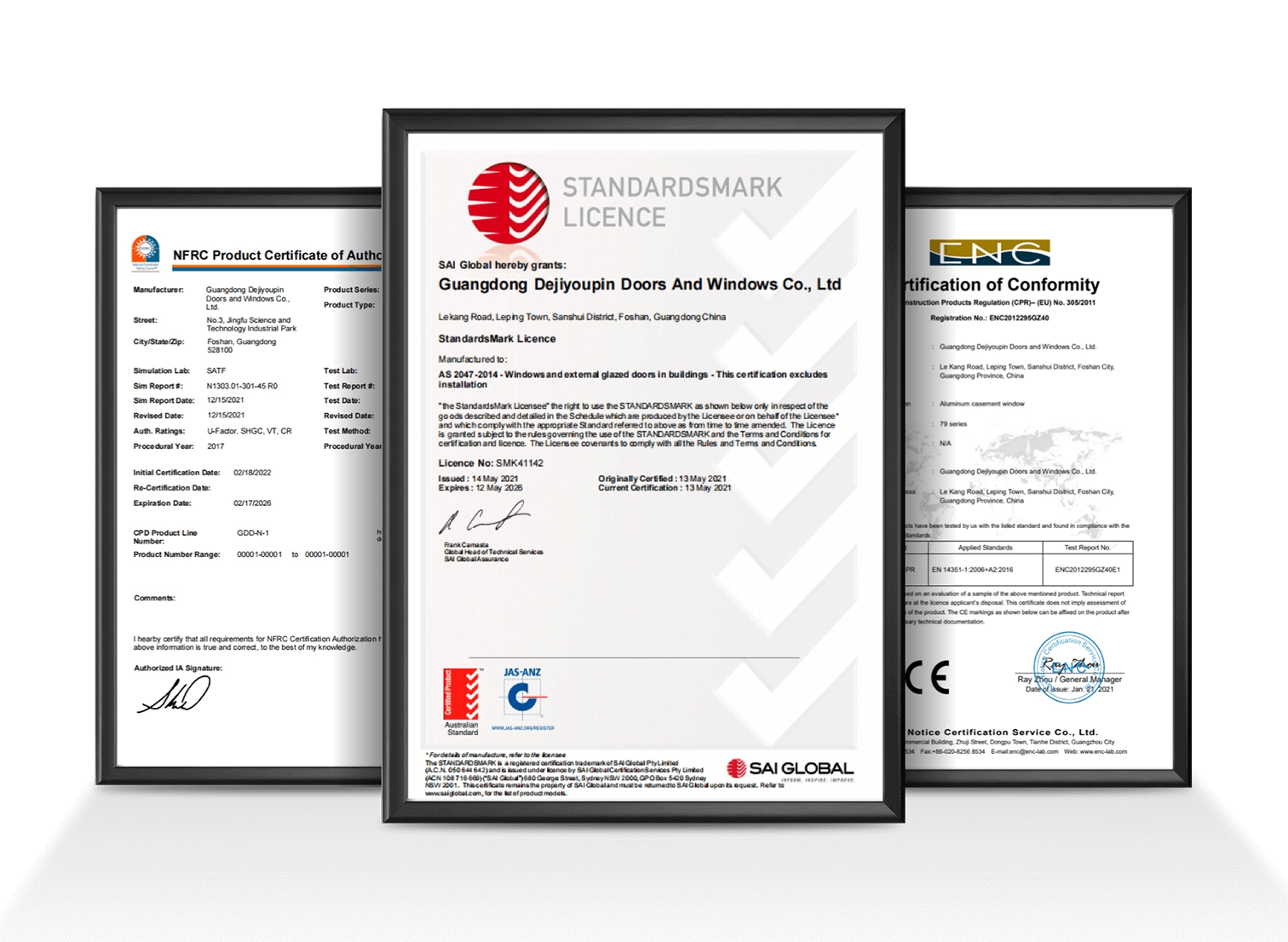
Procuring from China necessitates audited lab compliance. DERCHI systems undergo rigorous physical testing covering Australian Standard AS 2047 (Pass to Cyclonic N6 tier), European Standard EN 14351-1, North American AAMA/WDMA/CSA 101, and stringent UL 10B/10C Fire Resistance ratings.
Every project batch is accompanied by comprehensive engineering submittals: finite element structural calculations, glass deflection analysis under extreme positive/negative wind loads (up to 4500 Pa), and certified acoustic attenuation reports.
Complimentary Shop Drawings
Our dedicated team of 30+ façade engineers generates comprehensive CAD shop drawings, Revit BIM models, and structural anchorage detail sets within 48 hours of architectural plan handover.
Corner Joint Injection
Unlike cheap mechanical-screw assembled frames, we utilize cast aluminium corner cleats, pneumatically crimped and pressure-injected with German two-component polyurethane corner adhesive (Kleiberit) for lifelong watertightness.
Seamless Continuous EPDM
We strictly adopt vulcanized continuous automotive-grade EPDM (Ethylene Propylene Diene Monomer) gaskets. Molded vulcanized corners eliminate the perimeter contraction gaps common with cheap plastic PVC strips.
Engineered Export Packaging
To survive multi-week ocean transit across South Asia, North America, and Australia, units are sealed in protective shrink film, armored with reinforced corner buffers, and bolted within fumigation-free plywood crates.
The commercial and luxury residential fenestration sectors are undergoing a massive transition driven by carbon tariffs, building efficiency mandates, and minimalist design movements.
Trend 01 · Glazing Innovation
Vacuum Insulated Glazing (VIG)
By evacuating the air cavity down to 0.1 Pa between two panes, VIG achieves center-of-glass U-values as low as 0.45 W/(m²·K) within an 8.3mm profile thickness. This matches the thermal insulation of a 300mm brick wall, allowing ultra-slim frames without double/triple cavity bulkiness.
Trend 02 · Envelope Architecture
Minimalist Micro-Sightlines
High-end architecture demands maximum daylight ratios. Leading Chinese extruders now embed sash profiles directly within building structural reveals, featuring interlock widths as narrow as 18mm while utilizing concealed multi-point rollers carrying up to 600 kg sashes effortlessly.
Trend 03 · Green Procurement
Hydro-Electric "Low-Carbon" Aluminium
With Europe’s Carbon Border Adjustment Mechanism (CBAM) taking effect, global buyers increasingly require Environmental Product Declarations (EPD). Tier-1 Chinese suppliers now offer certified "Green Aluminium" smelted using renewable hydro-power, cutting profile carbon footprint by over 65%.
Trend 04 · Smart Buildings
Concealed Mechatronic Actuators
Integration of automated concealed motors within window frames allows natural night cooling, automated smoke ventilation (compliant with EN 12101-2), and synchronization with smart home KNX/Zigbee protocols, complete with concealed solar-powered battery backup.
Trend 05 · Acoustic Defense
Side-Pressure Compression Sealing
Traditional sliding windows leak air and noise via brush seals. Next-generation sliding systems deploy side-pressure compression geometry: when closed, the operable sash shifts laterally 8mm against structural neoprene gaskets, achieving casement-level air tightness and 42dB acoustic isolation.
Trend 06 · Climate Adaptation
Cyclonic Water Deflection Sills
In response to extreme monsoon seasons across South Asia and hurricane activity in coastal zones, patented cascade step-down drainage sills prevent static pressure blow-back, handling water column tests up to 700 Pa without requiring interior weep-hole drainage caps.
Risk Mitigation Strategy
How Global Importers Audit China Window Manufacturers
Eliminate supply-chain friction, defective extrusions, and port delays with this proven 4-stage engineering verification protocol for commercial developers and distributors.
STAGE 01
Profile & Material Audit
✓ Request mill test certificates for 6063-T5/T6 alloy composition.
Frequently Asked Questions: Sourcing Aluminium Windows from China
Critical engineering, financial, and logistical insights for general contractors, property developers, and window distributors.
What are the key price factors when importing aluminium windows from China?
Wholesale prices are shaped by four core parameters: (1) Aluminium profile specification: primary 6063-T5 billet vs. recycled aluminium, profile wall thickness (1.4mm to 2.0mm+), and thermal break system (non-insulated vs. 24mm–34mm PA66 GF25 polyamide strips); (2) Glazing build-up: single tempered, double insulated Low-E (with argon gas), triple acoustic laminates, or vacuum glass; (3) Hardware system: domestic certified brands (Chugn, Kinlong) versus high-tier European engineered hardware (CMECH, Hoppe, Siegenia, Roto); and (4) Surface coating: standard electrostatic powder coating, Class 1 anodizing, or PVDF 3-coat fluorocarbon with AAMA 2605 20-year coastal warranties.
How do Chinese aluminium windows compare to European brands like Schüco or Reynaers?
Top-tier Chinese manufacturers (such as DERCHI) utilize identical CNC machining centers (German Elumatec), premium polyamide thermal barriers (Technoform Bautec), and world-class hardware systems (Siegenia, CMECH) matching European structural and thermal performance. The primary difference lies in procurement economics: sourcing directly from Foshan, China delivers equivalent U-values, acoustic ratings, and cycle longevity at 40% to 65% lower landed costs due to vertical supply chain integration, automated volume production, and direct factory distribution.
What international testing standards must be specified for project compliance?
Depending on your destination jurisdiction, you should mandate: Australia & New Zealand: AS 2047 (structural deflection, air infiltration, water penetration up to N6 cyclone rating) and AS 1288 (safety glazing); North America: AAMA/WDMA/CSA 101/I.S.2/A440 (NAFS), NFRC thermal certification (U-factor & SHGC), and ASTM E1886/E1996 hurricane impact test standards; United Kingdom & Europe: CE Marking under EN 14351-1, Document L compliance for U-values, and PAS 24 security testing; Middle East & South Asia: ISO 9001, civil defense fire-rated certifications, and coastal salt spray tests (ASTM B117 > 3,000 hours).
What is the standard production lead time and shipping process for B2B container orders?
Standard production lead time ranges between 25 and 35 working days following shop drawing approval and deposit receipt. Custom architectural colors or non-standard curved extrusions require an additional 7–10 days. Shipments are typically quoted on FOB (Nansha, Shenzhen, Hong Kong) or CIF terms to international destinations. Ocean transit generally requires: 12–18 days to Southeast Asian & Indian ports (Nhava Sheva, Chennai, Colombo); 20–28 days to Middle Eastern ports (Jebel Ali, Dammam); 25–35 days to US/Canada West Coast; and 30–40 days to European main ports (Rotterdam, Felixstowe).
How do manufacturers prevent glass breakage and profile scratches during sea freight?
Leading export factories execute an industrial five-tier protective procedure: (1) Laser-protective surface film applied to all exposed aluminium profiles; (2) Heavy-duty impact-absorbing corner protectors installed on all four sash and frame corners; (3) Moisture-barrier thermal shrink-wrapping surrounding each completed unit; (4) Insertion of high-density EVA rubber separator blocks between nested panels; and (5) Vertical crating within fumigation-free solid plywood crates reinforced with galvanized steel bands and internal seismic air-cushion dunnage bags inside the shipping container.
Can Chinese manufacturers accommodate custom architectural drawings and small trial orders?
Yes. Every architectural window order is custom made-to-measure. In-house engineering teams produce 2D CAD elevations, cross-sectional connection details, and 3D BIM models matched to your wall schedule. While full 20ft or 40ft container loads provide optimal freight efficiency, trial sample orders (e.g., mock-up windows for villa prototypes or commercial façade mock-up testing) are readily accommodated under LCL (Less than Container Load) shipping protocols.
Accelerate Your Architectural Project with Factory-Direct Pricing
Submit your window schedule, architectural drawings, or bill of quantities. Our senior façade engineering team will provide comprehensive CAD cross-sections and itemized FOB/CIF quotations within 24 hours.