Certified Pivot Assemblies & Architectural Systems
Direct-from-factory high-performance systems deployed across high-density hospitality, institutional complexes, and luxury villa estates across Addis Ababa and beyond.
25+
Years Manufacturing Heritage
180k m²
Precision Production Base
120 Min
Certified UL / EN Fire Integrity
100+
International Patents & Certs
The Structural Mechanics of Oversized Fire-Rated Pivot Doors
Analyzing why pivoting entry systems present unique thermal-expansion and containment challenges under Ethiopian building codes.
Information Gain Specification: Standard side-hung butt-hinge doors transfer the entire cantilevered gravitational load to vertical jamb profiles. When exposed to fire conditions exceeding 900°C, the torque creates catastrophic hinge pull-out and frame warping. Pivot mechanisms distribute multi-ton leaf weights downward into deep floor recesses, eliminating cantilever sag and ensuring that intumescent perimeter seals retain zero-tolerance smoke containment under extreme heat exposure.
As the capital city of Ethiopia, Addis Ababa, undergoes a rapid high-rise metamorphosis—spurred by major infrastructural modernization along the Bole Road, Kirkos, and Lideta sub-cities—architectural specifications have migrated decisively toward large-format monumental entrances. However, implementing pivot doors within commercial egress corridors, diplomatic residences, and luxury multi-family towers requires solving the complex thermodynamics of passive fire containment. In traditional swinging systems, lateral hinge stress exacerbates warping under the standard ISO 834 or ASTM E119 time-temperature curve. Conversely, an engineered fire-rated pivot door transfers structural dead loads perpendicularly through a bottom pivot spindle anchored directly into structural concrete substrates.
For Ethiopian specifiers, the manufacturing design must combine heavy structural aluminum or reinforced steel chassis with non-combustible internal insulating cores—primarily high-density perlite boards and ceramic silicate wool blankets. Under standard fire conditions, the core halts thermal conductivity, ensuring the unexposed face temperature remains below the 140°C threshold mandated by international life safety standards. Furthermore, heavy-duty floor pivots fitted with integrated hydraulic dampening mechanisms (featuring EN 1154 compliant electromagnetic hold-open linkages) guarantee instantaneous self-closing upon receiving alarms from central building automation systems (BAS).
Deployment Scenarios in the Ethiopian Urban Landscape
Balancing thermal performance, extreme ultraviolet exposure at high altitudes, and strict commercial life-safety standards.
Diplomatic & Headquarters Enclaves
The concentration of international bodies, including the African Union (AU) Headquarters and UNECA in Addis Ababa, imposes stringent ballistic-resistant, physical security, and UL 90-minute fire compartmentalization mandates on all entry portals.
Kirkos / Bole CorridorHigh-Density Mixed-Use Towers
Modern mega-developments along Churchill Avenue require certified fire-rated glass and composite metal pivot portals that separate bustling podium commercial gallerias from residential elevator cores without visual blockage.
Commercial Core Real EstateLuxury Villas & Gated Compounds
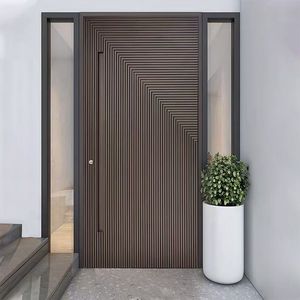
Exclusive residential communities across Old Airport, Jackros, and Ayat favor grand 2.4m to 3.5m tall architectural pivot doors. High altitude (2,355m above sea level) requires UV-stabilized fluorocarbon finishes resistant to solar oxidation.
Addis Suburban MansionsFire Integrity & Material Performance Comparison
Quantitative analysis contrasting conventional wooden doors, standard hollow metal doors, and DERCHI’s engineered fire-rated pivot assemblies.
| Performance Metrics | Solid Timber Core Entrance | Standard Hollow Metal Door | DERCHI Fire-Rated Pivot Door |
|---|---|---|---|
| Fire Integrity Rating | 20 - 30 Minutes Max | 60 - 90 Minutes | 60 - 120 Minutes (UL 10C / EN 1634) |
| Leaf Dimension Capability | Max 1000mm W × 2400mm H | Max 1100mm W × 2400mm H | Up to 2200mm W × 4500mm H |
| Hinge Torque & Sagging | High Risk (Thermal creep failure) | Moderate (Hinge fatigue) | Zero Cantilever Stress (Floor Pivot Bearings) |
| UV & High Altitude Stability | Prone to surface checking & cracking | Moderate (Fades within 3 years) | Qualicoat Class 2 / PVDF 30-Yr Resistance |
| Acoustic Isolation (Rw) | 28 - 32 dB | 30 - 35 dB | 40 - 46 dB (Hermetic Double Compression) |
| Life Cycle in Heavy Traffic | 50,000 Cycles | 100,000 Cycles | 1,000,000+ Cycles (Heavy-Duty Mechanics) |
Ethiopian Building Codes, Regulatory Mandates & Fire Life-Safety Oversight
Procurement managers and general contractors working under the Ethiopian Ministry of Urban Development and Infrastructure (MUDI) framework and the Ethiopian Standards Agency (ESA) must navigate a structured regulatory transition. Historically, commercial projects in Addis Ababa relied on basic British Standard (BS 476) assessments or general fire clearance issued by local municipal fire departments. Today, building codes—specifically Ethiopian Building Proclamation No. 624/2009 and updated directives for tall and complex building designs—align closely with international standards such as EN 1634-1, NFPA 80, and UL 10C (positive pressure fire testing).
A key regulatory mandate centers around unhindered emergency egress. When an entrance door acts simultaneously as a monumental pivot centerpiece and a primary or secondary fire exit route, it must feature tested hardware configurations. Panic egress push bars, electromagnetic releases integrated into localized smoke detection matrices, and fail-safe hydraulic bottom pivots are compulsory. DERCHI's pivot units utilize intumescent graphite fire seals embedded seamlessly within internal grooves. During a fire event, these seals swell up to 25 times their initial volume at 190°C, sealing perimeter gaps against superheated gases and toxic carbon monoxide—the primary cause of casualty in high-rise fires.
Macroeconomic Trends Shaping Architectural Procurement in East Africa
Addis Ababa Urban Renewal
The sweeping corridor development project along Addis Ababa's central arteries has initiated large-scale renovations, driving developers to replace aging wooden and non-certified metal portals with modern, certified architectural pivot entrances.
Foreign Direct Investment (FDI) Facilities
Industrial parks (such as Bole Lemi, Hawassa, and Kilinto) together with global technology clusters require standardized, factory-certified commercial fire doors that comply with overseas risk underwriting policies.
Climate Adaptation & Energy Efficiency
Addis Ababa sits at over 2,300 meters above sea level with distinct wet and dry seasons and high daytime solar radiation. Thermal-break aluminum profiles prevent interior heat transfer and lower operational air conditioning costs.
Procurement Workflow: Freight Routing, Djibouti Corridor & Banking Regulations
Importing architectural products directly from Guangdong Dejiyoupin Doors and Windows Co., Ltd. in Foshan into Ethiopia requires meticulous logistics and banking alignment. Because Ethiopia is a landlocked nation, the logistical lifeline relies heavily on the maritime trade route terminating at the Port of Djibouti:
- Port of Loading to Port of Discharge: FCL shipments leave Shenzhen or Nansha port and arrive at the Port of Djibouti via standard Red Sea / Gulf of Aden maritime rotations in approximately 18 to 26 days.
- Inland Multimodal Transport: Containers transfer directly from the container terminal to the Addis Ababa–Djibouti Railway or via specialized truck convoys through Galafi, entering the Modjo Dry Port (Ethiopia’s primary inland logistics hub) for customs processing.
- Protective Export Packaging: DERCHI safeguards all products with multi-layered polyethylene films, thick EPS impact-absorbing corners, moisture desiccant packs, and reinforced fumigated steel-banded wooden crates to prevent damage across overland routes.
- National Bank of Ethiopia (NBE) Financial Compliance: We support Ethiopian importers with Letters of Credit (L/C), Cash Against Documents (CAD), and import permits, providing certified commercial invoices, packing lists, clean bills of lading, and conformity documentation.
Frequently Asked Questions for Ethiopian Specifiers
In-depth technical answers addressing fire certifications, structural floor anchorage, glass configurations, and warranty terms.
Can an oversized pivot door truly pass a 90-minute or 120-minute positive-pressure fire test? +
Yes. Our fire-rated pivot assemblies are engineered and tested in accordance with UL 10C, NFPA 252, and EN 1634-1 standards under positive furnace pressure. Standard swinging doors often pull away from their frames at high temperatures due to uneven thermal expansion. Our pivot doors, however, feature high-strength alloy sub-frames reinforced with internal steel stiffeners and high-density perlite/ceramic mineral cores. When exposed to heat, internal intumescent seals expand to block drafts and flames. The bottom floor pivot assembly is protected inside an insulated sub-floor enclosure, keeping thermal bridging below critical yield points for up to 120 minutes.
How do you prevent water infiltration and dust ingress during the Ethiopian rainy season (Kiremt)? +
The heavy rains of Kiremt, combined with Addis Ababa's elevation winds, require specialized sealing. Pivot doors rotate along an offset axis, which makes traditional stepped rebate frames challenging. To solve this, DERCHI integrates a dual-action perimeter sealing system. When the door closes, automatic concealed drop-down acoustic and weather seals activate at the top and bottom rails, compressing against a flush floor tracker. Along the vertical jambs, multi-fin EPDM co-extruded gaskets interlock against the leaf profile, preventing wind-driven rain and volcanic dust from breaching the building interior.
What structural floor preparation is required prior to installing a heavy-duty pivot door? +
Because leaf weights can exceed 400 kg to 800 kg on monumental systems, structural floor anchorage is critical. The structural contractor must provide a reinforced concrete recess (typically 120mm to 160mm deep) at the designated pivot centerline to house the heavy-duty hydraulic floor spring. We provide detailed CAD/BIM shop drawings indicating exact anchor positions, load-bearing weight vectors, and electrical conduit access for access-control systems before pouring the finished screed.
Are fire-rated glazed pivot options available for luxury hotel lobbies and upscale residences? +
Absolutely. We manufacture fire-rated glass pivot doors utilizing specialized intumescent laminated fire glass (Class EI). Unlike standard single-sheet tempered glass, our glass consists of multiple float glass layers separated by clear intumescent interlayers. Under fire conditions, these interlayers transform into an opaque heat-shield foam wall, stopping both flame propagation (Integrity - E) and radiant thermal transmission (Insulation - I) for 30, 60, or 90 minutes.
How does DERCHI assist Ethiopian contractors with customs clearance and documentation at Modjo Dry Port? +
Our dedicated international documentation team prepares comprehensive import records tailored to Ethiopian Customs and Revenue Authority (ECRA) standards. This includes chamber-verified Certificates of Origin, clean Bills of Lading designating Modjo Dry Port as the ultimate multimodal destination, full factory test and inspection reports, and HS code classifications to ensure smooth customs audits and prevent demurrage charges.
Can access control systems (such as facial recognition and biometric readers) be integrated into fire-rated pivot assemblies? +
Yes. Commercial and diplomatic facilities in Ethiopia often require biometric or RFID security integration. We engineer concealed concealed power transfers (CPT) within the upper pivot axis, allowing low-voltage wiring to reach electric multi-point latching hardware without compromising internal fire cores or exterior design aesthetics. In an emergency, the system fail-safes open to ensure immediate egress compliance.
The DERCHI Manufacturing Advantage
Over a quarter-century of continuous innovation, global engineering compliance, and industrial-scale fabrication.
180,000 m² Production Base
Operating from Foshan, Guangdong—the world’s leading epicenter of aluminum fenestration—our facilities employ automated German 5-axis CNC machining centers, automated powder-coating lines, and robotic thermal-break crimping assemblies.
600+ Skilled Workforce & In-House R&D
Our dedicated team of structural engineers, metallurgists, and technical draftsmen provides comprehensive project support, creating custom CAD/BIM shop drawings tailored to complex architectural schedules across Africa.
Rigorous International Certifications
Our manufacturing protocols adhere to strict ISO 9001 standards, holding verified international certifications including CE, Australian AS 2047, and UL fire ratings, backed by more than 30 active design and utility patents.
Initiate Your Ethiopian Project Consultation
Whether you are designing a high-rise along the Bole Road corridor, developing an international hotel property, or curating a luxury residential compound, our engineering team is ready to deliver certified fire ratings, CAD shop drawings, and competitive direct-factory pricing.